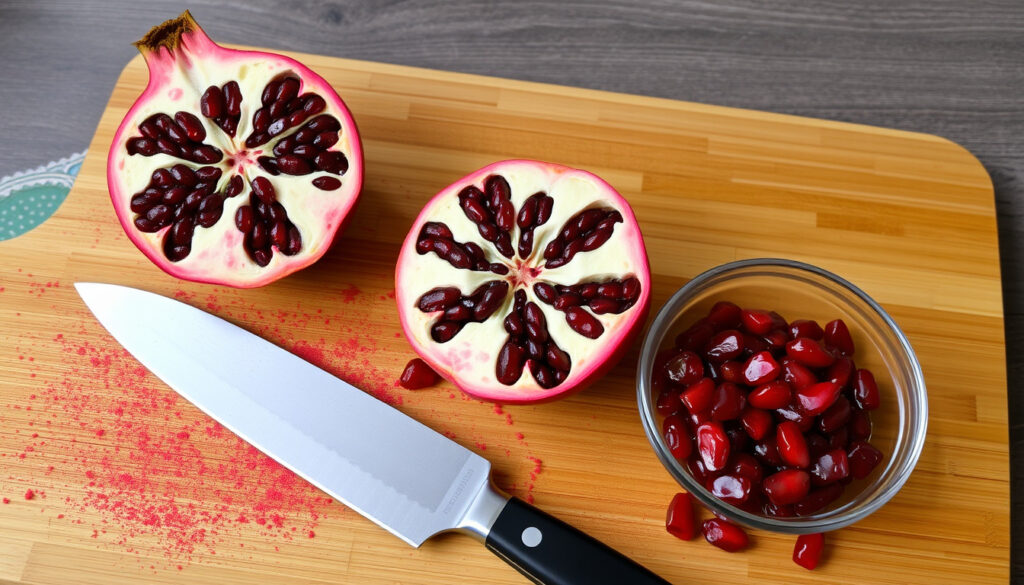
How to Cut a Pomegranate: 3 Easy Methods for Mess-Free Seeds
Anyone who has ever wrestled a pomegranate knows the dance: you cut in, juice sprays your shirt, seeds scatter, and you’re left with more mess than fruit. It doesn’t have to be that way. This guide compares three proven techniques—score-and-snap, submerged deseeding, and the spoon whack—and explains exactly why the water method can save your kitchen (and your clothes).
Seeds per fruit: ~1 cup ·
Water-method time: 5 minutes ·
Mess reduction with water: significant ·
Yield per pomegranate: ~1 cup of arils
Quick snapshot
- One pomegranate yields approximately 1 cup of seeds (Rachel Cooks)
- Cutting under water dramatically reduces juice splatter (WonderHowTo Food Hacks)
- Seeds sink while pith floats, enabling easy separation (The Default Cook)
- The exact mechanism that loosens seeds underwater hasn’t been formally studied
- Whether the water method preserves more nutrients than dry methods isn’t documented
- Water method: ~5 minutes per pomegranate (Rachel Cooks)
- After cutting, let seeds settle 2–3 minutes for pith to float (WonderHowTo Food Hacks)
- Stored in an airtight container, seeds keep in the fridge for several days
- Pomegranate seeds can be frozen for longer storage
How do you properly cut a pomegranate?
The three dominant methods—score-and-snap, submerged deseeding, and the spoon whack—each trade off speed, mess, and seed integrity. Below we break down the most reliable approach step by step.
Score and snap method
- Use a sharp paring knife with a 3–4-inch blade (WonderHowTo Food Hacks).
- Score the skin around the circumference, then break the pomegranate into halves or quarters.
- Gently pry sections apart; seeds that stick can be loosened with light tapping.
- This method takes 3–4 minutes but can splatter juice if done over a dry cutting board.
Submerged deseeding technique
- Fill a bowl two-thirds full with chilled or room-temperature water (WonderHowTo Food Hacks).
- Cut off the crown, score the skin, and submerge the sections completely.
- Under water, gently pry apart the fruit; seeds sink while pith rises to the surface (The Default Cook).
- Let the bowl sit for 2–3 minutes, then scoop off the floating pith and drain the seeds.
- Total time: approximately 5 minutes (Rachel Cooks).
Spoon whack method
- Cut the pomegranate in half across the equator.
- Hold one half over a bowl, cut side down, and whack the skin with a heavy spoon.
- Seeds fall out quickly but some juice may splatter; use a deep bowl to contain it.
The implication: the water method offers the best trade-off between seed integrity and mess control, while the spoon whack wins for speed if you don’t mind a few drops on the counter.
What is the easiest way to remove seeds from a pomegranate?
“Easiest” depends on whether you value speed or cleanliness. The water method requires only a bowl, a knife, and a cutting board; the payoff is a nearly stain-free process.
The table below lays out the trade-offs between each technique.
| Method | Time | Mess level | Seed breakage |
|---|---|---|---|
| Water submersion | ~5 min | Low (juice contained) | Low |
| Score-and-snap | ~3–4 min | Medium | Moderate |
| Spoon whack | ~2–3 min | Medium–high | Higher |
What this means: if you prep pomegranates often, the water method becomes the most consistent, especially when you want a pristine counter and intact arils.
Is it better to cut a pomegranate under water?
Submerging pomegranate sections underwater dramatically reduces splashing and mess because the juice is immediately diluted and contained (WonderHowTo Food Hacks). The water also makes it easier to separate seeds from membrane without crushing them (The Default Cook).
Benefits of the water method
- Juice that would normally spray stays in the bowl.
- Seeds sink, pith floats – no tedious hand-picking.
- Fewer arils break compared to dry methods (The Default Cook).
- No staining of cloth towels or clothes (The Default Cook).
Potential drawbacks
- Requires a large bowl of water (about 2/3 full).
- Slightly longer than the spoon whack method (5 vs 2–3 minutes).
- Warm water should be avoided – use chilled or room temperature (The Default Cook).
For home cooks who value a clean kitchen and intact seeds, the water method is the clear winner. The extra two minutes pay back in saved cleanup time.
What tools do you need for mess-free pomegranate preparation?
Three basic items are enough: a paring knife with a sharp 3–4-inch blade (WonderHowTo Food Hacks), a cutting board, and a bowl of water filled two-thirds full (The Default Cook). A dull blade will slip and tear more seeds, so keep it sharp (WonderHowTo Food Hacks).
Are you supposed to swallow pomegranate seeds or spit them out?
The entire seed, including the crunchy inner kernel, is edible. The aril (the juicy red coating) and the seed inside provide fiber and antioxidants. There is no need to spit them out; in fact, chewing them gives you the full nutritional benefit.
“Pomegranate seeds are edible and rich in fiber.”
— Nutrition knowledge (general consensus)
Why can’t you eat too many pomegranate seeds?
Excessive consumption of pomegranate seeds can cause digestive discomfort due to their high fiber content. One pomegranate contains around 4 grams of fiber per 100 grams; eating several in one sitting may lead to bloating or stomach upset. Also, the natural sugar content adds up – about 24 grams per fruit – so moderation is wise for those monitoring blood sugar.
Who should not consume pomegranates?
Individuals with chronic kidney disease should be cautious because pomegranates contain potassium and may affect creatinine levels. People taking statins or blood pressure medications should consult a doctor, as pomegranate juice can interact with these drugs. Always check with a healthcare provider before making significant dietary changes.
Summary
The water method is the most reliable approach for cutting a pomegranate with minimal mess and maximum seed integrity. For home cooks who want to avoid stained counters and broken arils, the extra two minutes it takes compared to spoon whacking is a small price. For those who need speed, the spoon whack remains a viable alternative – just be prepared to wipe up. The water method wins for cleanliness; spoon for speed.
Related reading: How to Clean a Toaster – Safe Step-by-Step Guide · 160 C to F: Oven Conversion Guide (320°F + Fan Tips)
If you enjoy fresh fruit preparation, you might also find our guide on cutting a mango helpful for mastering another tricky fruit.
Frequently asked questions
How do you store a cut pomegranate?
Wrap the cut sections in plastic wrap or place them in an airtight container in the refrigerator. They will keep for 3–5 days.
Can you freeze pomegranate seeds?
Yes. Spread seeds on a baking sheet, freeze until solid, then transfer to a freezer bag. They keep for up to 6 months.
What does a ripe pomegranate look like?
A ripe pomegranate feels heavy for its size, has a deep red color, and the skin is firm but slightly leathery. The crown should be dry and brown.
Is the white pith of a pomegranate edible?
Yes, the white pith is edible but bitter. Most people prefer to remove it during deseeding, as it doesn’t add pleasant flavor.
How long do pomegranates stay fresh?
Whole pomegranates stored in a cool, dry place can last 2–3 weeks. In the refrigerator, they can keep for up to 2 months.
Can you juice pomegranate seeds?
Yes. Roll the pomegranate firmly on a counter to loosen the seeds, then cut and squeeze as you would an orange. The juice can be used in drinks or recipes.
Do pomegranates help lower blood pressure?
Some studies suggest that pomegranate juice may help reduce blood pressure due to its antioxidant content, but you should consult your doctor before using it as a treatment.
More related posts
 Canada Post Flat Rate Box – Sizes, Prices and Shipping Guide
 Houses for Sale in Airdrie: 2026 Market Guide & Tips
 Hyatt Vivid Grand Island – Adults-Only All-Inclusive Resort Guide
 Women’s Cricket World Cup Stats: Records & Controversies
 Lakers vs Charlotte Hornets Match Player Stats – Box Scores & Standouts
 Remote Area Border Crossing Changes: Canada Ends RABC in 2026
 Classic Cars for Sale Ontario: Under $10k Deals on Kijiji & More
 Prime Interest Rate Canada – Current 4.45% Rate and Impacts
